Global commerce depends on trust, but trust in cross-border deals hinges on more than good intentions—it rests on the exact wording of contracts that span languages and legal systems. For multinational companies sealing sales agreements or appointing overseas agents, a single mistranslated clause can flip the balance of power overnight. Executives often sign off after skimming a concise Chinese summary, only to discover during a dispute that the English version binds them to far stricter terms. The result? Unexpected liabilities, lost revenue, and lengthy battles that drain resources.
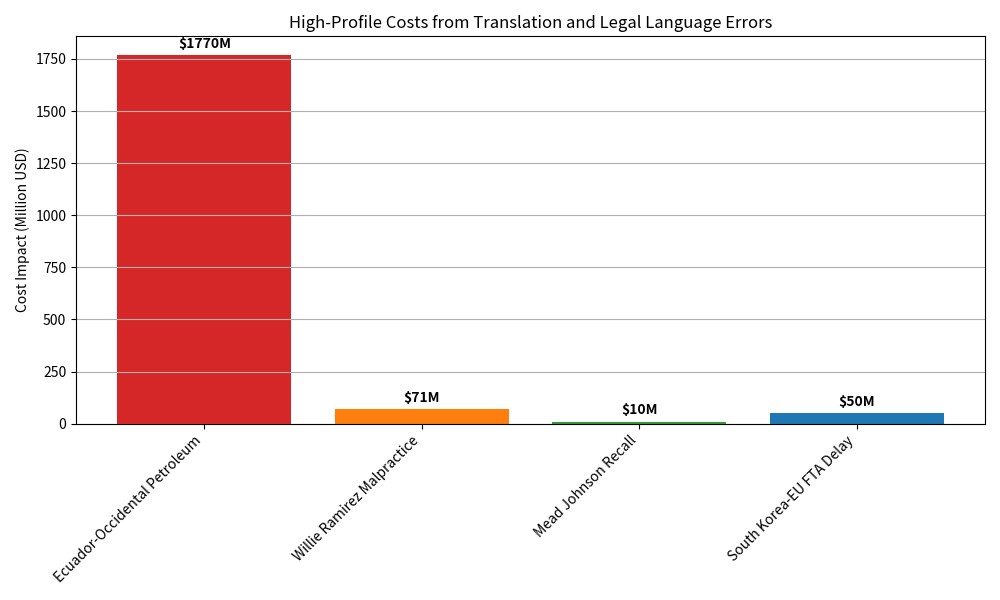
Real-world numbers drive the point home. One high-profile arbitration saw Ecuador ordered to pay Occidental Petroleum roughly $1.77 billion after a tribunal interpreted poorly translated documents in a way that undermined the government’s position. A medical malpractice settlement reached $71 million when a single Spanish word was rendered incorrectly, shifting the entire understanding of a patient’s condition. Even a consumer product recall triggered by faulty instructions in translated materials cost one company over $10 million and forced millions of units off shelves. These are not isolated anecdotes; they illustrate how language gaps in legal documents routinely escalate into multi-million-dollar headaches.
To isolate risk effectively, translators must deliver precise, side-by-side mappings of the two most volatile sections: force majeure (不可抗力) and dispute resolution. Anything less invites ambiguity that courts or tribunals will resolve against the party that drafted the weaker version.
Force Majeure Clauses: Preserving the Shield Against the Unexpected
In Chinese commercial law, 不可抗力 is tightly defined under the Civil Code as an “objective circumstance that is unforeseeable, unavoidable, and insurmountable.” The English counterpart, “force majeure,” traditionally lists specific events to leave no room for interpretation. A standard bilingual rendering that survives scrutiny looks like this:
English:“A party shall not be liable for any failure or delay in performing its obligations under this Agreement to the extent that such failure or delay is caused by an event of Force Majeure, which means any event or circumstance beyond the reasonable control of the affected party, including but not limited to: acts of God (fire, flood, earthquake, storm, or other natural disaster), war, invasion, hostilities (whether war is declared or not), rebellion, revolution, insurrection, terrorist acts, government sanctions, embargo, blockade, labor disputes, strikes, lockouts, or interruption or failure of utility services.”
Chinese (standard equivalent):“一方不对因不可抗力事件导致其未能或延迟履行本协议项下义务承担责任。不可抗力指超出受影响方合理控制的任何事件或情形,包括但不限于:天灾(火灾、洪水、地震、风暴或其他自然灾害)、战争、入侵、敌对行为(无论是否宣战)、叛乱、革命、起义、恐怖活动、政府制裁、禁运、封锁、劳资纠纷、罢工、停工或公用事业服务的中断或故障。”
The mapping works because every listed event is anchored to the Chinese legal test of “unforeseeable, unavoidable, and insurmountable.” Casual paraphrasing—shortening the list to “natural disasters and government actions” or replacing “beyond reasonable control” with a vaguer “unexpected event”—opens the door to arguments that a pandemic, supply-chain blockade, or new export restriction does not qualify. In one documented China-related arbitration, a party successfully invoked force majeure for a government order only because the clause explicitly named “government sanction” and “embargo”; a looser version would have left them liable for millions in damages.
Dispute Resolution Clauses: Choosing the Battlefield Before the War Begins
Dispute resolution language determines not just where a fight occurs but whether the winner can actually collect. Cross-border sales and agency contracts commonly stipulate:
English:“Any dispute, controversy or claim arising out of or relating to this Agreement, including its existence, validity, interpretation, performance, breach or termination, shall be finally settled by arbitration in [Singapore / Hong Kong] under the rules of the [SIAC / HKIAC] by one or more arbitrators appointed in accordance with those rules. The language of the arbitration shall be English. The governing law of this Agreement shall be the laws of [England / Singapore] excluding conflict of laws principles.”
Chinese mapping:“因本协议产生或与之相关的任何争议、纠纷或索赔,包括其存在、效力、解释、履行、违约或终止,均应通过在[新加坡/香港]根据[新加坡国际仲裁中心/香港国际仲裁中心]规则由根据该规则任命的一名或多名仲裁员进行仲裁最终解决。仲裁语言为英语。本协议的准据法为[英国/新加坡]法律(不包括法律冲突原则)。”
Why this level of detail? Arbitration awards are enforceable in more than 170 jurisdictions under the New York Convention, while court judgments often require separate recognition proceedings that can drag on for years. In China-related deals, choosing mainland litigation or arbitration can limit options; offshore venues paired with foreign governing law sometimes complicate enforcement against local assets. A loosely translated clause that says only “disputes shall be resolved by friendly negotiation or arbitration” has been struck down in Chinese courts for lack of specificity, leaving parties stuck in local litigation they never wanted.
The Peril of Shortcuts: Why Deleting or Freely Paraphrasing Long Sentences Backfires
Legal English is deliberately dense for a reason—every subordinate clause, “including but not limited to,” and “to the extent that” carves out or reinforces protection. When non-specialist translators or in-house teams delete half a sentence to “make it readable” or substitute “force majeure” with “不可预见事件” without the full statutory test, the contract no longer says what the parties intended. In arbitration, tribunals apply the plain meaning of the words on the page. A shortened version that once protected a party from liability for a three-month factory shutdown suddenly exposes them to breach claims worth tens of millions.
Executives who rely solely on Chinese abstracts discover this mismatch only when lawyers on the other side wave the English original and say, “Your version says something different.” By then the damage is done: unfavorable jurisdiction, narrowed remedies, or outright unenforceability.
Practical Steps That Actually Lock In Protection
Seasoned legal teams insist on three non-negotiable practices. First, engage translators who hold legal qualifications in both jurisdictions and maintain current knowledge of PRC Contract Law and common-law precedents. Second, require a full bilingual comparison table for every critical clause, not just a clean final document. Third, explicitly designate the prevailing language in the contract itself—most often English for international enforceability—while ensuring the Chinese version mirrors it exactly.
These steps transform translation from a cost center into a strategic risk barrier.
Companies that treat cross-border contract translation with the seriousness it deserves rarely face the nightmare of discovering their “protective” English clauses actually work against them. Those that do pay a steep price in time, money, and market position. Firms such as Artlangs Translation stand out here: proficient in more than 230 languages and honed over years of focused work in translation services, video localization, short drama subtitle localization, game localization for short dramas and audiobooks, plus multi-language dubbing and data annotation transcription, they have guided numerous enterprises through complex multilingual agreements with documented success. Their track record shows that when precision meets experience, commercial interests stay firmly locked in place—no matter which side of the border the dispute lands.