Getting a patent license agreement to work seamlessly across borders means far more than swapping one language for another. Every royalty rate, every exclusivity term, every geographic boundary has to land with the exact same legal punch in the target market. When it doesn’t, the revenue stream that looked so solid on paper can start leaking fast.
I’ve watched companies walk into international licensing deals full of confidence, only to discover months later that a single mistranslated phrase has flipped “exclusive rights in Europe” into something the licensee interpreted as worldwide control. Or a royalty trigger worded just loosely enough in the local language that payments mysteriously dried up. These aren’t hypothetical headaches—they’re the kinds of surprises that send finance teams scrambling and legal departments into damage-control mode.
The Hidden Costs of Getting It Wrong
The pain usually starts with three classic trouble spots: exclusivity, royalties, and territory. A licensee might read an exclusivity clause and assume they have sole rights everywhere, while the original intent was strictly regional. Suddenly you’re facing overlapping sales, eroded pricing power, and royalty shortfalls you never budgeted for.
Royalty calculations are even trickier. Terms like “net sales after deductions” or “milestone payments upon regulatory approval” carry razor-sharp definitions in the source language. In patent royalty translation, the slightest drift in meaning can lead to underreporting, delayed audits, or outright disputes. And territorial limits? One ambiguous country reference is all it takes for unauthorized sales to creep into protected markets, turning a clean license into an infringement fight.
Numbers back this up. A Steinbeis Institute study found that 58% of IP professionals view translation errors as a “latent risk” to their international patent portfolios. More than a quarter had seen cases where poor translation seriously damaged an applicant’s ability to enforce rights. And when disputes escalate, the bills pile up quickly.
Take a look at what the 2023 AIPLA Economic Survey reports for patent cases where less than $1 million is at stake:
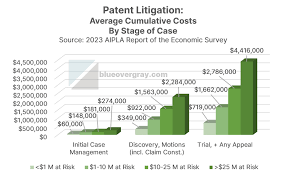
Even at the lower end, you’re looking at roughly $349,000 just to get through discovery and claim construction, then another jump to about $719,000 if it heads to trial and appeal. Those figures don’t include the lost time, strained partnerships, or opportunity cost of money that should have been flowing as royalties instead of lawyer fees.
Breaking Down the Clauses That Matter Most
The sections that demand surgical precision tend to be the same ones that trip people up:
Exclusivity clause localization – This defines whether the licensee gets sole rights or has to share the field. The wording has to close every loophole; otherwise the licensor loses control over pricing, distribution, and competitive positioning.
Royalty provisions – Rates, payment schedules, currency rules, audit rights—all need exact equivalence. Patent royalty translation here is non-negotiable if you want the cash to arrive on time and in full.
Territorial scope – Every country or region must be spelled out without room for creative interpretation. Vague boundaries invite court challenges and can render enforcement rights useless.
Term, termination, and survival clauses – Duration, post-expiration obligations, and what happens if things go south. Lose a cultural or legal nuance here and liabilities can stretch far beyond what anyone intended.
Specialist translators who live and breathe both patent law and the target jurisdiction treat these clauses like high-stakes contracts themselves—because they are.
Turning Precision into Protected Revenue
When patent license contract translation is handled with true expertise, royalty streams stay intact. Exclusivity means what it’s supposed to mean. Payments trigger exactly when they should. Territories stay clean. The result? Fewer renegotiations, more predictable income, and the confidence to invest in scaling without looking over your shoulder.
The broader market tells the story. The global intellectual property licensing sector is projected to climb past $20 billion by 2030 as more companies look to monetize patents internationally. Those who treat translation as a core part of their IP strategy consistently report smoother deals and stronger returns. The ones who treat it as an afterthought often learn the real cost only after the dispute has already started.
Bottom line: in cross-border patent licensing, language isn’t just a detail—it’s the foundation. Get the wording right and your global strategy holds. Let it slip and you’re essentially handing the keys to someone else.
For companies that refuse to take that risk, the right partner changes everything. Artlangs Translation has spent years mastering more than 230 languages with a sharp focus on translation services, video localization, short drama subtitle localization, game localization, short drama and audiobook multilingual dubbing, plus multilingual data annotation and transcription. Their portfolio of real-world cases shows exactly how meticulous, jurisdiction-savvy work turns complex licensing agreements into secure, revenue-protecting assets for long-term global success.