Translation pricing has a bad habit of feeling like a black box. You ask for a quote, get a number that seems reasonable, then discover extra line items for “project management,” “QA rounds,” or “file formatting” that no one mentioned upfront. For companies exploring MTPE—machine translation post-editing—the uncertainty hits harder because you’re mixing fast AI output with human refinement. In 2026, though, the industry has moved toward clearer models. Providers who want repeat business are finally laying out exactly what drives the bill.
MTPE works by letting neural engines produce a first draft at machine speed, then having professional editors clean it up. The final price depends on how much human work is required, the language pair, the subject matter, and whether you need light touch-ups or a deep polish. The biggest variable? The level of post-editing itself.
How MTPE Pricing Models Actually Work in 2026
Most legitimate providers still quote by the word count of the source text. It’s predictable, easy to compare, and scales cleanly with volume. Hourly rates pop up occasionally—usually $35–$85 per editor hour—but they’re more common for very short jobs or when the content is so specialized that word-count math breaks down.
What you won’t see from transparent partners are surprise “minimum fees” or vague “complexity surcharges” tacked on after the fact. Real quotes spell out the editing level, any volume discounts, and turnaround expectations right from the start.
Light Post-Editing (LPE) vs. Full Post-Editing (FPE): The Cost Gap Explained
This is where the real difference shows up. Not every MTPE job needs the same intensity of human work, and the pricing reflects that.
Light Post-Editing (LPE) focuses on fixing only the obvious problems—grammar glitches, spelling slips, and major meaning distortions. The goal is “understandable and usable,” not literary perfection. It’s ideal for internal reports, large knowledge-base articles, or drafts meant for quick review.
Full Post-Editing (FPE) goes further. Editors rework phrasing for natural flow, enforce strict terminology, adjust tone, and ensure cultural fit. This level is what you need for client-facing content, contracts, financial disclosures, or anything that will face regulators or the public.
The cost difference is significant because FPE simply demands more skilled time.
Here’s a clear 2026 benchmark based on aggregated industry data:
Light Post-Editing (LPE): $0.03 – $0.08 per word
Full Post-Editing (FPE): $0.08 – $0.15 per word
Traditional human translation (for comparison): $0.09 – $0.35 per word
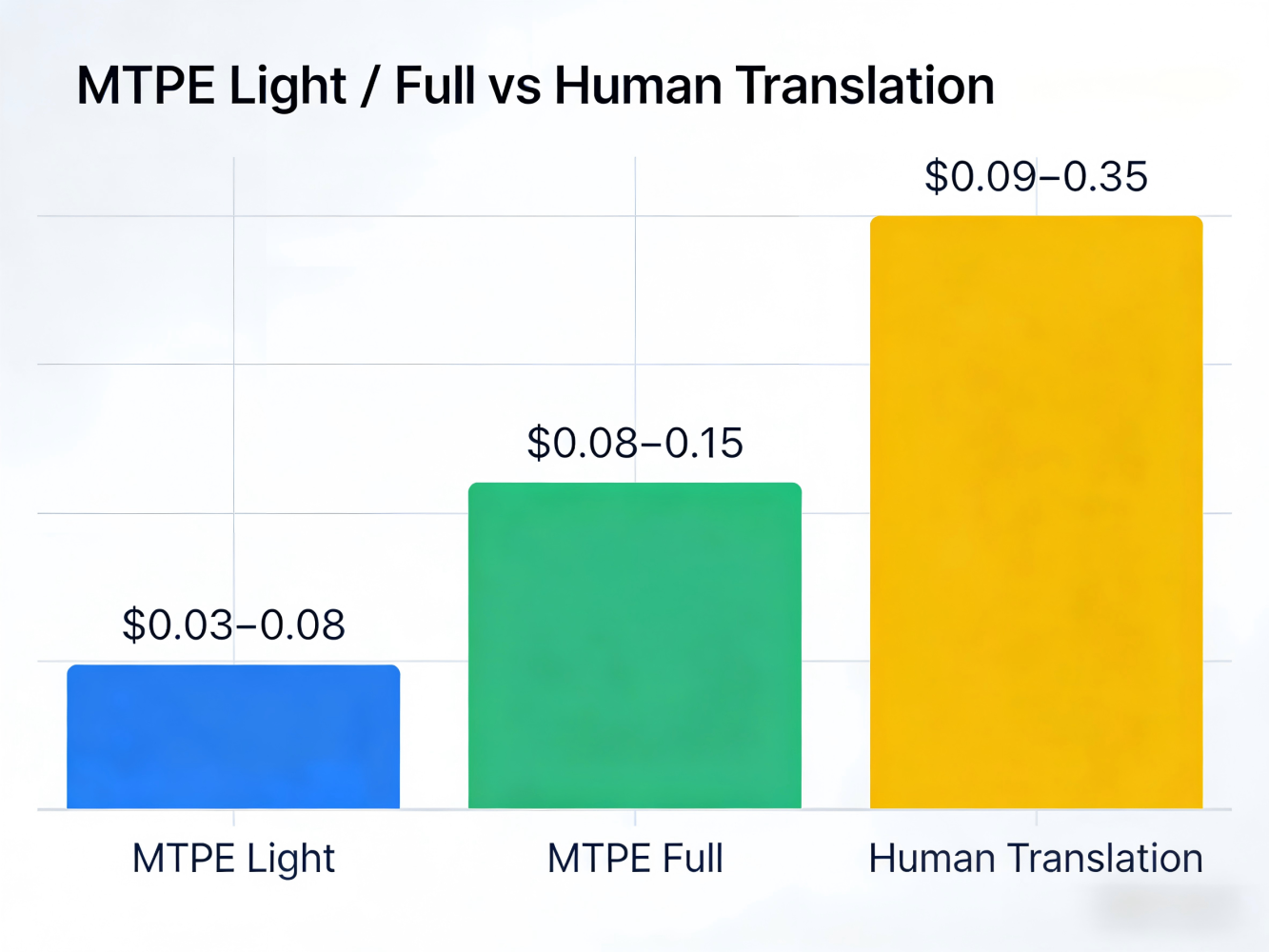
That gap adds up fast. A 50,000-word technical manual might run $2,000–$4,000 with LPE but jump to $4,000–$7,500 with FPE. Switch to full human translation and you’re easily looking at $8,000–$15,000 or more, depending on the languages.
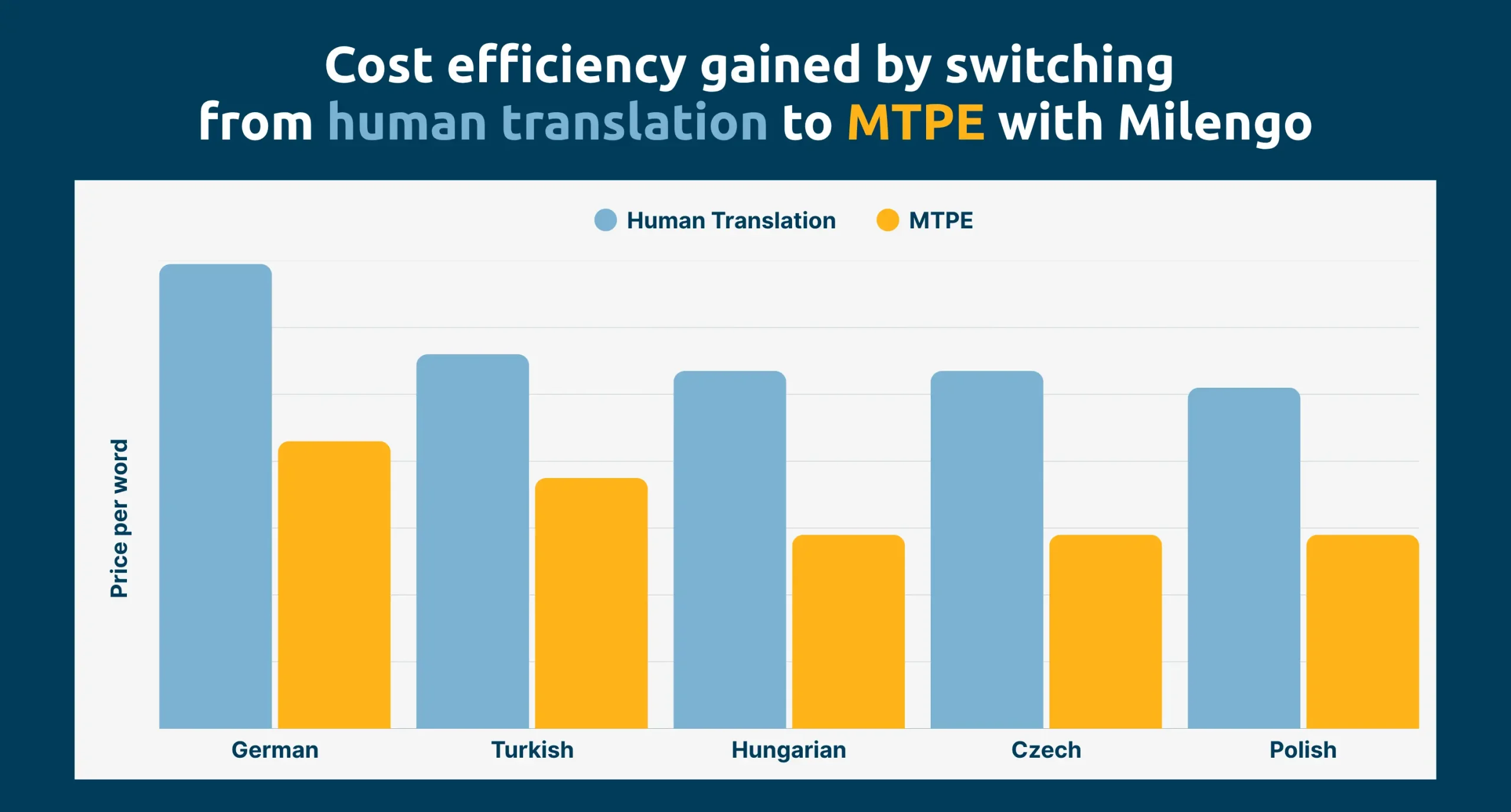
MTPE vs Human Translation: Which is Right for Your Business? - Artlangs
What Actually Moves the Price Needle
Several factors sit behind those ranges:
Language pair — Common pairs like English–Spanish or English–German sit at the lower end. Rare or high-demand combinations (English–Arabic, English–Japanese, or anything involving lesser-spoken languages) push costs 20–50% higher.
Content type — Straightforward marketing copy is cheaper than dense legal or financial text that demands subject-matter expertise.
Volume — Bigger projects almost always qualify for tiered discounts. Many providers drop 10–25% once you cross 50,000 or 100,000 words.
Turnaround — Standard delivery might take 3–5 business days; rush jobs (24–48 hours) carry a 25–50% premium.
Extra services — Glossary creation, custom engine fine-tuning, or certified QA add-ons increase the total but are quoted separately and transparently.
Real-World Examples That Remove the Guesswork
Let’s make it concrete. A mid-sized fintech company needed 80,000 words of investor reports translated from English into German, French, and Spanish. Using LPE for internal versions kept the bill around $0.05 per word—roughly $12,000 total across three languages. When the same team switched the final public filings to FPE, the rate rose to $0.12 per word, but the quality matched what regulators expected and the project still landed 45% below a full human translation quote.
Another client—an international law firm—routinely runs discovery documents through LPE for speed during early case review, then applies targeted FPE only to the 15–20% of pages that actually get filed. The hybrid approach slashed their annual translation spend by more than 40% while keeping every court submission bulletproof.
How to Protect Yourself from Hidden Fees
Ask these questions before you sign anything:
Is the price per source word or target word?
Does the quote lock in the editing level (LPE or FPE)?
Are there any minimum charges or setup fees?
What happens if the machine output is unusually poor—does the rate stay the same?
Can I see a sample edit before the full project starts?
Providers who answer clearly and without hesitation are the ones worth working with.
In 2026, MTPE translation rates have become one of the more straightforward line items in the localization budget—provided you choose partners who treat transparency as a feature, not an afterthought. The technology keeps getting sharper, the savings remain substantial, and the quality gap between light and full editing is now well understood.
For teams that want both competitive rates and genuine expertise across more than 230 languages, Artlangs Translation has spent years perfecting exactly this balance. Their focus on translation services, video localization, short drama subtitle localization, game localization, multilingual dubbing for short dramas and audiobooks, plus multilingual data annotation and transcription has given them a deep bench of proven case studies and the kind of practical experience that turns pricing transparency into real, measurable value. When the numbers line up and the quality holds, the decision becomes a lot easier.