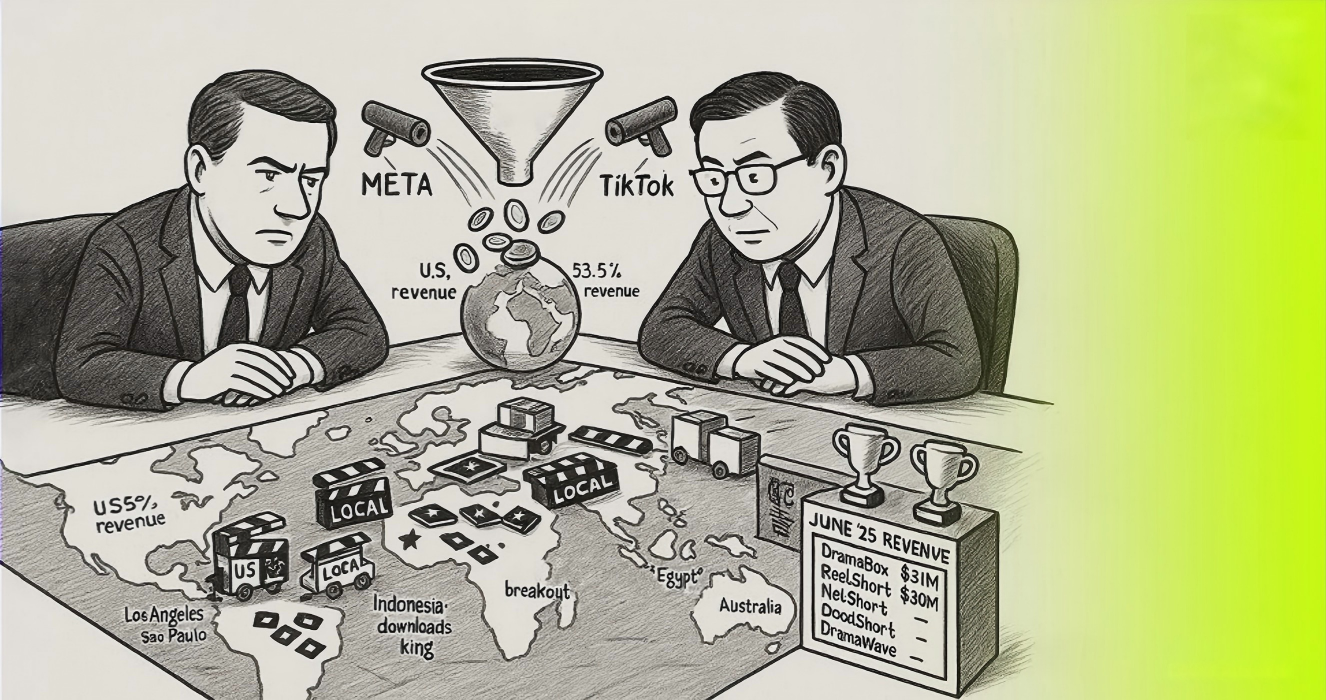
English short drama is becoming expensive.
CPMs on ReelShort's core markets have increased 140% since January 2025. The CAC for an English-speaking subscriber is now roughly 4x what it was 18 months ago, while the ARPU hasn't moved proportionally. The unit economics still work for content that performs in the top quartile, but the distribution of performance is brutal — most short drama series never recover their customer acquisition spend, and the math gets worse every quarter as more studios pile into the same inventory.
This isn't a crisis. It's a signal. The studios building sustainable businesses right now are the ones that got ahead of the English-language saturation and started distributing into markets where the competitive density is lower and the audience appetite is demonstrably real.
Latin America. Southern Europe. These aren't speculative bets. They're markets where short-form mobile drama has cultural precedent, where the audience already spends 3+ hours per day on the platforms where micro-drama distributes, and where the cost of reaching them is a fraction of what English-language acquisition costs now demand.
The question isn't whether to go multi-language. It's which market to enter first, with what content, at what budget, and with what quality standard. That question has a structured answer.
The market reality: Latin America vs Southern Europe
Let me be direct about what the data shows and what the intuition misses.
Latin America — particularly Brazil, Mexico, and Colombia — has the most immediate audience overlap with the short drama format. Brazilian audiences have deep engagement with telenovela structures. Mexican audiences have the highest per-capita mobile video consumption in Latin America. Colombian production infrastructure for scripted content exists and is underutilized. The cultural affinity for serialized drama with emotional stakes, family dynamics, revenge arcs, and romantic tension is baked into the audience's existing viewing habits. The localization challenge for Brazilian Portuguese is moderate; for Mexican Spanish it's low — Mexican Spanish dubbing is considered a gold standard in the Latin American market, and audiences notice when content uses other regional varieties.
Southern Europe — Spain, Italy, France, and Portugal — is a more fragmented opportunity. Spain has the strongest cultural fit for drama content, but the dubbing market is expensive and the window for dubbed content on streaming platforms is competitive. Italy has demonstrated micro-drama appetite on TikTok but has less established payment infrastructure for short-form drama subscriptions. France's market is structurally resistant to dubbed content in certain demographics — younger French audiences prefer subtitled content and have historically rejected overdubbing, which creates a subtitling-first strategy consideration.
⚠ The false choice most studios make: 'Portuguese or Spanish first?' The real question is 'Brazil or Mexico?' These are different markets with different dynamics, different production ecosystems, and different audience profiles. Portuguese for Brazil and Spanish for Mexico aren't interchangeable decisions.
The critical factor most expansion strategies ignore: dubbing quality tolerance varies by market. Latin American audiences for Spanish-language content have a high tolerance for Mexican-standard dubbing. European Spanish audiences do not — they notice and reject Castilian dubbing of Latin American-targeted content, and they notice Latin American dubbing of European-targeted content. You cannot make one Spanish version and expect it to serve both markets.
A framework for the entry decision
I've built a four-variable framework for evaluating multi-language market entry for short drama. It isn't a scoring model — it won't give you a rank-ordered list. What it does is force explicit consideration of the variables that actually determine whether a given market entry is profitable.
Variable 1: Audience Content Fit (1-10) — Does the drama format have cultural precedent in this market? Does serialized emotional storytelling match existing viewing habits? Latin American markets score 8-9. Southern European markets score 6-8 with more variation.
Variable 2: Competitive Density (1-10, inverse) — How many short drama titles are already competing for this audience's attention in this language? Low density = high score. English: 2-3. Brazilian Portuguese: 6-7. Mexican Spanish: 5-6. French: 7-8. European Spanish: 7.
Variable 3: Acquisition Cost Ratio (estimated) — What is the estimated CPM and CAC relative to English? Brazilian Portuguese: approximately 45-55% of English CPM. Mexican Spanish: approximately 50-60%. European Spanish: approximately 60-70%. French: approximately 65-75%. These are directional estimates and fluctuate by quarter.
Variable 4: Localization Quality Requirement (qualitative) — What quality threshold does this market tolerate before audience retention drops? High tolerance: Brazilian Portuguese, Mexican Spanish. Low tolerance: European Spanish, French. Studios that localize with generalist-quality dubbing into high-quality-expectation markets see significantly worse retention curves.
The ROI model you build from these variables should model three scenarios: aggressive (content-first entry with lower localization investment), standard (content-matched localization quality), and premium (localization quality matched to the top content already in market). Run the math for 90-day and 180-day payback windows and compare against your English-language unit economics.
Budget allocation: what the field actually looks like
The studios that fail at multi-language expansion tend to make the same mistake: they treat localization as a cost line item to be minimized rather than a market entry investment with an expected return profile. They spend $12,000 localizing a series into Brazilian Portuguese using a generalist dubbing house, get mediocre retention metrics, conclude that the Brazilian market doesn't work, and exit before understanding that the problem wasn't the market — it was the $12,000 dubbing quality.
A more useful budget framework for initial market entry:
• Phase 1 (Months 1-2): Single-market pilot. Pick either Brazil or Mexico — not both. Invest in production-quality localization: native voice casting, professional studio recording, cultural adaptation of scripts, lip-sync to platform standards. Set a clear go/no-go decision point at 60 days based on retention and engagement data, not just subscriber count.
• Phase 2 (Months 3-4): If Phase 1 shows positive unit economics, expand to the second Latin American market. If the first pilot underperformed, diagnose before expanding: was it content fit, localization quality, or distribution channel? Each has a different fix.
• Phase 3 (Months 5-6): Enter European market. By this point, you've learned enough about your audience data to make a more informed decision about which European market and whether to prioritize dubbing or subtitling.
• Ongoing: Build a localization workflow that doesn't require rebuilding the pipeline for each new language. The studios with sustainable multi-language operations have invested in localization infrastructure — translation memories, terminology databases, voice casting relationships — that reduce marginal cost per language over time.
The studios winning multi-language right now didn't start with all markets simultaneously. They entered deliberately, learned fast, and built the operational capacity to scale once the playbook was proven.
The localization quality threshold nobody talks about
Short drama audiences are not passive. They're making a split-second decision about whether to continue watching after the first episode, and that decision is heavily influenced by whether the dialogue sounds like something a real person would say in their language. Generalist dubbing produces dialogue that is technically correct and emotionally inert. The lip-sync is approximate, the vocal performances are flat, the emotional beats land a half-second late, and the audience can feel that something is off even if they can't articulate why.
The retention differential between generalist and specialist dubbing in short drama is significant. In markets where the content format is culturally established — Brazil, Mexico — audiences have a reference point for what good dubbing sounds like from their experience with telenovela and streaming dubbing. Studios that localize with generalist quality are competing against that reference point, and they lose.
What this means for your strategy
English short drama saturation isn't a temporary condition. It's the new baseline. The studios that will be building defensible businesses in 18 months are the ones building multi-language distribution now, while competitive density is still lower in non-English markets and audience acquisition costs are still rational.
The decision between Latin America and Southern Europe isn't binary, and it shouldn't be made based on gut instinct. Build the four-variable model. Run the scenarios. Make the Phase 1 commitment with enough quality investment to generate meaningful data. Learn from what the audience tells you. Then scale.
The market isn't waiting. But it is forgiving of studios that enter thoughtfully.
Artlangs Translation supports short drama multi-language distribution with the localization quality standard that high-retention markets demand. We handle script cultural adaptation, professional native-voice casting, studio-quality dubbing in Mexican Spanish, Brazilian Portuguese, European Spanish, French, Italian, and German, and platform-ready subtitling. Our micro-drama localization pipeline is built for the volume and speed that short drama distribution requires. If you're entering Latin America or Europe with short drama content, the question isn't whether you can afford quality localization — it's whether you can afford the audience retention loss from getting it wrong.