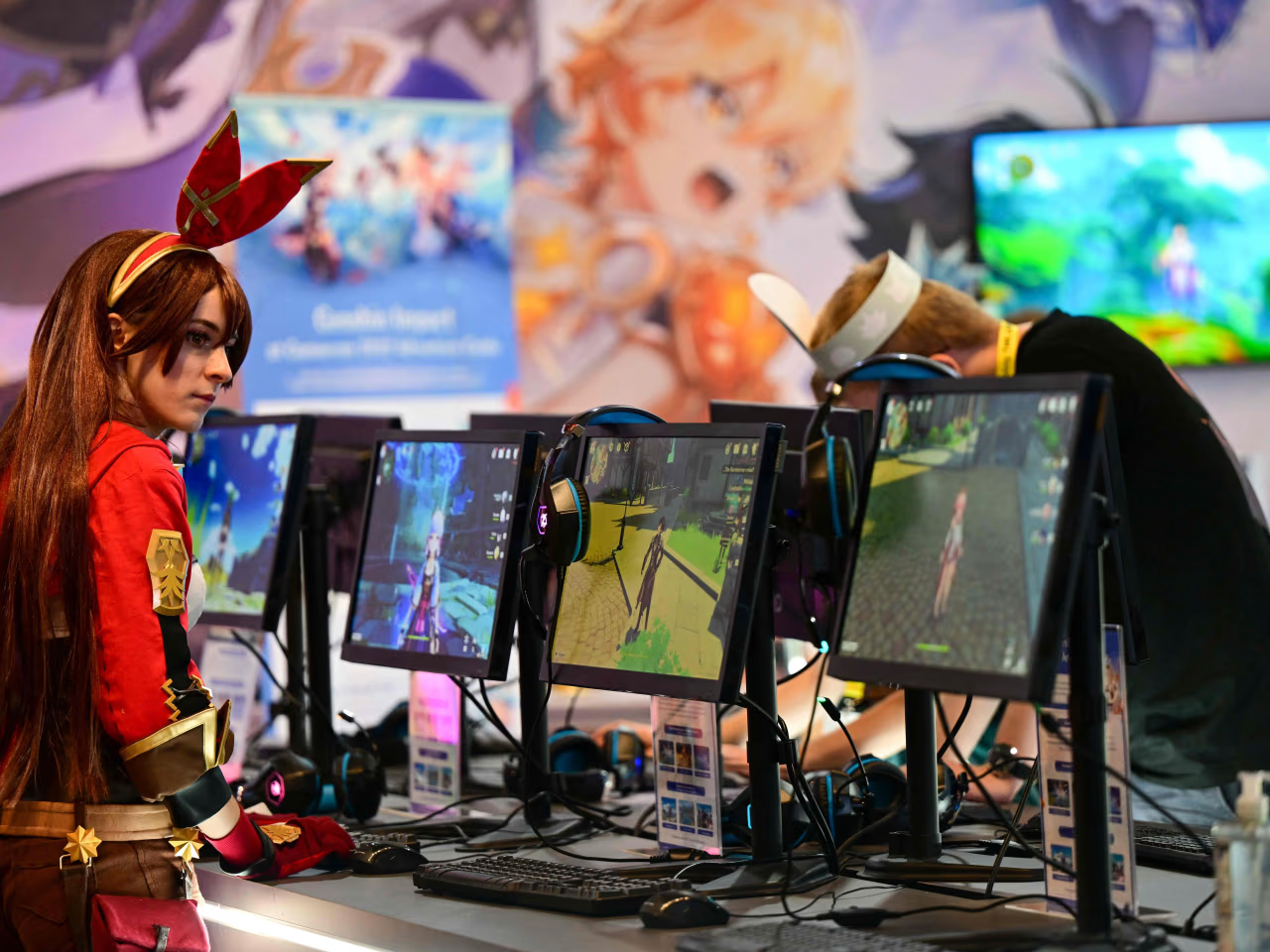
A gacha RPG. Released globally. Spent 72 hours in the Korean app store top 10.
Then the Korean community found it.
Two weeks later: 2.8 stars. The Korean-language reviews weren't about the gameplay loop or the monetization model. They were about the translation. Specifically: the dialogue was 'like Google Translate.' The item descriptions were 'wrong.' The honorifics were 'randomly applied.' The in-game mail that the community manager sent apologizing for server issues used a formality level that made it sound like a debt collection notice.
The developers' response in the community forum was instructive. They said they'd localized the game into 12 languages for the global launch and that the Korean version had been reviewed by a native speaker. Which was technically accurate. And irrelevant. Because a native speaker who reviewed a bad translation and shipped it anyway didn't make the translation good. They just made it a reviewed bad translation.
This is the situation facing every game publisher trying to enter the Korean market. Korean players are not a forgiving audience. They're not just numerically large — South Korea has one of the highest smartphone penetration rates in the world and a gaming culture that treats game literacy as a baseline expectation. They know what good game translation looks like. They've played Korean-developed games with Korean-developed localization quality. Holding a Korean translation to the standard of Korean-developed games is not unreasonable. It's just expensive.
What Korean players are actually evaluating when they review a game's Korean version
The Korean gaming community has a set of criteria it applies to evaluating game localization that isn't formally codified anywhere but is universally understood among the community. I'm going to try to articulate it because understanding it is the prerequisite for not getting burned.
Semantic accuracy in context. This is different from literal accuracy. Korean is a language where the same sentence said in different formality registers can mean completely different things — the same proposition delivered as a request, a command, a suggestion, a complaint, or a warning depending on the ending. MT or inexperienced translators will get the proposition right and get the register wrong. A Korean player reads a dialogue option that should be 'I appreciate you helping me' and gets 'you've been helpful, I suppose' — same literal content, completely different social meaning. The player doesn't think 'hmm, interesting register choice.' They think the character is being written inconsistently.
Item and system naming consistency. RPG systems — equipment, skills, status effects, quest objectives — require consistent terminology throughout. Korean players who have played dozens of Korean and localized RPGs know what the standard translation conventions are for these systems. They have expectations. When those expectations are violated — when 'stun' is translated as '재료' (confusion) instead of '추진' (knockback), or when the same status effect is called three different things across different item descriptions — Korean players notice immediately. This is the single most common localization failure mode in Korean game translation that I've seen, and it's almost always a term management failure rather than a translation failure.
Cultural legibility. This is the one that trips up developers most because it's not about language quality per se. It's about whether the cultural context being referenced in the source content is legible to a Korean audience. A joke that depends on a specific Western cultural reference will land differently in Korean. A historical allusion that reads as epic in English might read as obscure or confusing in Korean if the reference isn't part of the Korean historical literacy baseline. A satirical take on American corporate culture might land as just confusing rather than satirical. The Korean version doesn't have to be culturally adapted — that would be a different project — but it has to be culturally legible. The player has to understand what the original was trying to do even if the specific reference doesn't land.
Voice acting and lip-sync standard. This one is specific to games with voice acting. Korean is a language where vowel duration and consonant tension change meaning. Lip-sync to Korean requires different animation timing than lip-sync to English because the phoneme inventory is different. A game that was animated for English lip-sync and then had Korean voice acting recorded to match it will have visibly off lip-sync in Korean, which Korean players find extremely distracting. The localization teams that understand this will either adjust the animation timing for the Korean version or select Korean voice actors specifically for their ability to deliver lines that match the existing animation timing. Either approach costs more than just recording the Korean voice lines without addressing the sync issue.
Community communication register. This is the one that keeps burning community managers. Korean community communication — in-game mail, forum posts, patch notes, community manager responses — has specific register conventions that are different from formal written Korean. In-game mail in a casual RPG should feel casual in Korean. Community manager responses to complaints should be apologetic in a specific Korean register that expresses genuine concern without being overly formal or, conversely, too casual. The community manager who sent the 'debt collection notice' apology I mentioned earlier wasn't trying to sound threatening. They were trying to sound appropriately formal and apologetic in a register they didn't understand well enough to calibrate.
Why Korean game localization costs what it costs
The first time a developer gets a Korean localization quote, the reaction is usually sticker shock. Korean game localization rates are higher than most other language pairs for reasons that are structural, not arbitrary.
The Korean gaming vocabulary is specialized and has strong conventions. A translator who is a native Korean speaker but doesn't have specific experience with Korean game terminology will produce Korean text that reads as generically formal rather than game-native. Korean players will feel that the game 'doesn't know how Korean games talk.' The specialized vocabulary — the exact Korean terms used for aggro, CC, DoT, HoT, pull, kite, and dozens of other gaming concepts — isn't standard formal Korean. It's a specialized register that evolved in Korean-language gaming communities over decades of MMORPG and MOBA play. A translator who knows the vocabulary is harder to find than a translator who knows Korean.
The honorific system is not optional. Korean has a politeness system that English doesn't. The politeness level used in character dialogue has to be consistent with the character's social position relative to the person they're addressing, and inconsistent honorific usage breaks character perception immediately. In English, a game can get away with a character being vaguely polite or vaguely casual. In Korean, there are specific rules about what formality level means what, and Korean players know them. The character who uses formal endings when speaking to their subordinate is breaking the social logic of the scene. The character who switches formality level mid-conversation without narrative justification is breaking character. A Korean translator who understands the honorific system as a character design tool, not just a translation problem, is rarer than a translator who can produce grammatically correct Korean.
Cultural consultation is often necessary. For games with culturally specific content — and increasingly, even games that aren't specifically set in Korean or Asian contexts have cultural dimensions that need consultation — having a Korean cultural consultant review the translation for legibility issues is a real cost that doesn't show up in per-word rates. It shows up in hours. It's also non-negotiable if you care about the Korean market, because the Korean community will identify every cultural legibility issue faster than you can patch it.
The review bomb that didn't have to happen
I want to go back to that gacha RPG. The one that went from top 10 to 2.8 stars in two weeks because of the Korean translation.
The reviews were mostly in Korean, which meant the developer had to translate them to understand what the community was saying. Which, in itself, is an instructive problem. But the substantive complaints, once translated, broke down into categories that are all fixable before launch:
Item description inconsistency: roughly 40% of the negative Korean reviews cited specific item descriptions where the effect description didn't match the actual in-game effect. This is a terminology management problem, not a translation problem. If the project had a term glossary enforced across all item descriptions, this wouldn't have happened.
Honorific register inconsistency: roughly 30% cited dialogue that felt 'wrong' in terms of how characters spoke to each other. The translator was applying formal endings too consistently, making all characters sound equally deferential regardless of their relationship dynamic. This is a translation quality problem, but it's a fixable one — the translator needed either more game context or more specific guidance on the honorific register system they were supposed to be implementing.
Community manager communication: the remaining 30% were almost entirely about the community manager's in-game mail and forum posts, which used a register that the community interpreted as cold and dismissive. The community manager wasn't trying to be cold. They were trying to be appropriately formal in Korean and missed.
None of these issues would have been caught by a standard linguistic QA pass. Linguistic QA checks for grammar, consistency, and accuracy. It doesn't check for whether the honorific system is being used correctly as a character design tool. It doesn't check for whether community manager communication is calibrated to community expectations. It doesn't catch the specific error where 'this item increases your movement speed' is technically accurate but the Korean community has a specific expectation for how movement speed increases are described in Korean-language games.
The game eventually recovered its rating after a substantial localization patch six weeks later. But the first six weeks are when a game's Korean player base forms its initial impression, and that impression is extremely sticky. The players who left in week two because of the translation didn't come back in week eight when it was fixed.
What actually changes the outcome
I've worked on Korean localizations that went well. The common thread isn't a bigger budget or more time, exactly. It's three specific things.
First: the Korean translator has actually played Korean games. Not just speaks Korean and can translate. Has played the RPGs, the MMOs, the MOBAs, the mobile gacha titles that Korean players have grown up with. They know the vocabulary because they've used it, not because they've looked it up. They know the register conventions because they've heard Korean voice actors use them in games they play. They know what a Korean player expects from a game's Korean version because they're a Korean player.
Second: the project has a Korean gaming glossary from day one. Not assembled during translation. Not built as the translators go. Built before translation starts, based on a review of the game's specific terminology set, cross-referenced against established Korean gaming conventions for equivalent systems. Enforced. Every translator on the project uses the same terms for the same concepts. This is the single most cost-effective localization quality investment that almost nobody does because it feels like overhead.
Third: community communication is handled by someone who is qualified to write Korean community communication, not just someone who speaks Korean. These are different skills. The register, the tone, the specific Korean conventions for how a game developer addresses a community after a server incident — this is a specialized communication form that doesn't overlap with game dialogue translation. The community manager who got burned in the gacha RPG example wasn't a bad person. They were a bad fit for Korean community communication specifically.
None of these three things are exotic requirements. They're basic best practices that are more important for Korean localization than for most other language pairs because Korean players are more sensitive to the specific dimensions of localization quality that Korean language and culture affect. The cost isn't exotic either — it's mostly about hiring criteria and process design, not about dramatically higher per-word rates. The difference between a bad Korean localization and a good one is often about who you hire, not how much you pay them.
Artlangs Translation handles Korean game localization with translators who are active Korean gamers first and translators second: specialized Korean gaming vocabulary, honorific system as character design tool, enforced gaming glossary from project start, Korean cultural legibility review, community register consultation for community communication. 230+ language pairs including Korean. If your Korean player community is about to find your translation, the time to fix it is before they find it.