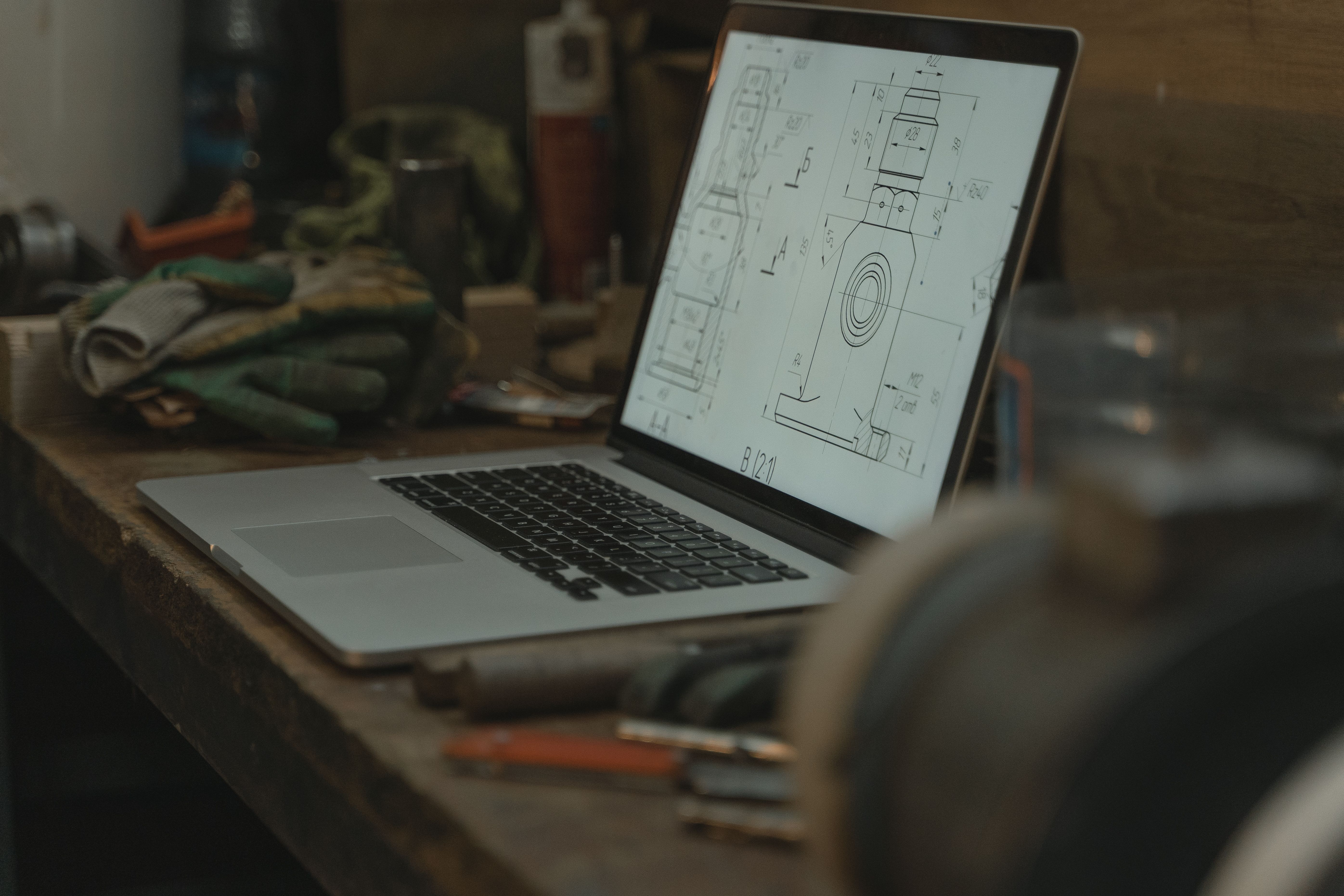
Mechanical patents live or die by the drawings. A suspension linkage, a multi-axis CNC spindle housing, or a simple four-bar mechanism is not just a collection of parts; it is a set of spatial relationships that must remain consistent from the first claim to the last reference numeral. When those relationships cross languages, the risk is rarely dramatic mistranslation of a technical noun. It is the quiet drift in orientation words, fit designations, and kinematic descriptions that examiners and courts later treat as changes in scope.
Global filing numbers make the stakes clear. Innovators filed roughly 3.7 million patent applications in 2024, a 4.9 percent rise from the previous year according to WIPO data. Mechanical engineering continues to represent a substantial share of PCT activity. Automotive systems, machine tools, and precision mechanisms generate dense assemblies where every “along the axial direction,” “radially inward,” or “relatively fixed” carries functional and legal weight. A survey by the Steinbeis Institute found that 81 percent of intellectual-property professionals have encountered translation errors in patents; more than a quarter of those errors caused serious damage to the scope of protection, and 58 percent of respondents viewed such mistakes as a latent risk to entire portfolios.
The difficulty is structural. Chinese, Japanese, and German source texts often embed directional language that depends on the viewing plane of a specific figure. “Inward” can reverse depending on whether the reader is looking at a front elevation or a cross-section. “Relatively fixed” may describe a rigid joint under load or merely a constrained degree of freedom during assembly. In linkage mechanisms common to automotive steering, robotic end-effectors, and CNC tool changers, the exact sequence of pivots, sliding joints, and fixed points defines the claimed motion. Shift one of those relationships and the kinematic chain changes. Geometric dimensioning and tolerancing adds another layer. ISO GPS and ASME Y14.5 share many symbols yet differ in default envelope requirements and independence principles. An H7/g6 fit rendered too loosely can alter manufacturing feasibility in the eyes of an examiner who knows the standards by heart.
Automotive engineering patents and CNC machine-tool filings amplify these problems. Suspension systems, steering linkages, and multi-axis machining centers produce nested assemblies with dozens of callouts. Translators who treat spatial terms as ordinary prepositions often produce text that is fluent yet functionally imprecise. The result is rarely an immediate rejection; it is an office action months later, or worse, a narrowed claim construction during enforcement. Real cases outside the mechanical field illustrate the same principle: a single word choice—“circular” versus “round,” or an imprecise rendering of a material state—has been enough to revoke or severely limit patents. Mechanical drawings simply raise the volume of opportunities for similar drift.
What works is not more general linguistic skill but constant cross-checking between text and drawing, combined with engineering literacy. Translators who understand how a clearance fit behaves under thermal expansion, or how a toggle linkage locks under load, are far less likely to introduce unintended freedom or constraint. Consistency of reference numerals across description, claims, and figures is non-negotiable; patent offices treat mismatches as clarity defects. Terminology must track established practice in the target jurisdiction rather than literal dictionary equivalents. These habits do not eliminate risk, but they keep the spatial and geometric content of the invention intact.
The same discipline applies when drawings themselves require localization. Labels, dimension notes, and surface-finish symbols must remain in exact register with the translated specification. Expansion or contraction of text length can force layout adjustments that, if handled carelessly, obscure other notations. Professional teams treat the CAD or vector files as integral to the legal disclosure rather than as after-the-fact illustrations.
Artlangs Translation approaches mechanical patent work with the combination of engineering background and linguistic precision these documents demand. With more than twenty years of specialized service experience, a network of over 20,000 professional linguists, and coverage across 230-plus languages, the company has delivered accurate renderings for complex assemblies in automotive, machine-tool, and industrial equipment filings. Beyond patent and technical translation, Artlangs supports video localization, short-drama subtitle work, game localization, multilingual dubbing for short-form content and audiobooks, and large-scale data annotation and transcription. The same insistence on technical fidelity that protects spatial relationships and tolerance schemes in mechanical patents carries through every service line.