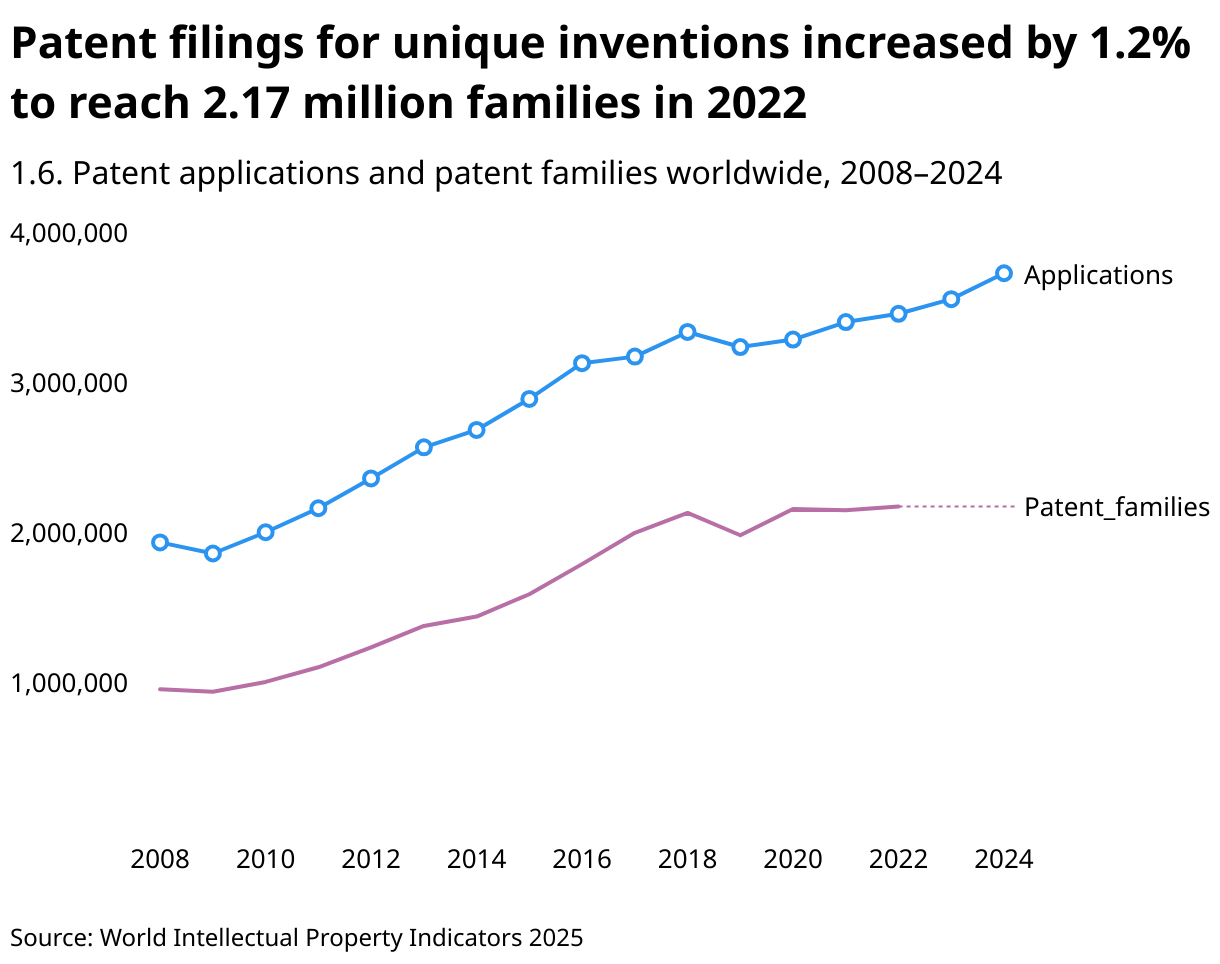
The numbers tell a clear story: in 2024 alone, innovators filed a record 3.7 million patent applications worldwide — a 4.9% jump from the year before, according to the World Intellectual Property Organization’s latest indicators. Within that surge, artificial intelligence now dominates entire technology classes. In the United States, AI-related patent grants climbed from 34,544 in 2020 to 54,022 in 2024. Globally, generative AI patent families exploded from just 733 in 2014 to more than 14,000 in 2023, now making up over 6% of all AI filings.
Yet raw volume is only half the challenge. The real difficulty lies in translating the inventions themselves.
AI and machine learning move at a pace no traditional legal translator can match. Terms that were cutting-edge yesterday become table stakes today. What began as “neural networks” evolved into “transformer architectures,” “self-attention mechanisms,” “large language models,” and now “agentic systems” and “multimodal reasoning chains.” In medical AI — one of the fastest-growing patent categories — the terminology is even more unforgiving: convolutional neural networks for lesion segmentation, federated learning across hospital networks, synthetic data generated by GANs to protect patient privacy, and continuous monitoring for data drift and concept drift.
A single mistranslated phrase can collapse an entire international filing strategy.
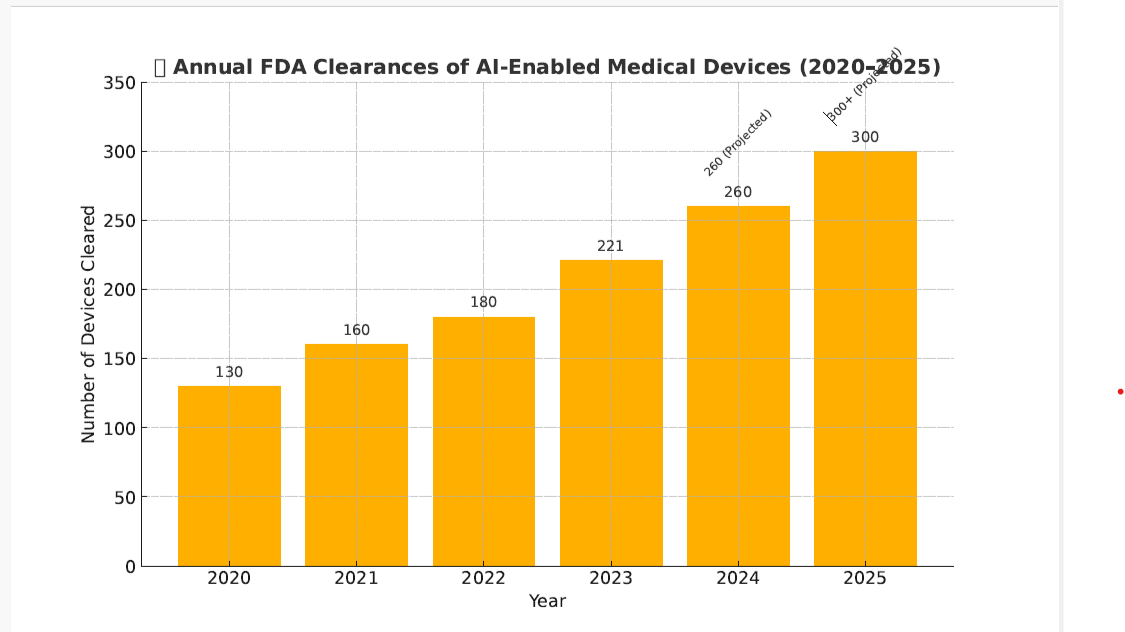
Regulatory bodies treat precision as non-negotiable. The FDA cleared 295 AI/ML-enabled medical devices in 2025 alone, bringing the cumulative total well past 1,400. These are not experimental tools — they are diagnostic systems that detect pulmonary nodules on CT scans, predict pharmacokinetic responses, and guide real-time surgical navigation. When a patent application reaches the FDA (or EMA) for related device approval, every anatomical term, every pharmacological descriptor, and every algorithmic claim must be identical in meaning across languages.
One misplaced word — “nodule” rendered as a vague “spot,” or “adversarial robustness” diluted into generic “security” — can trigger a Refuse-To-Accept letter or outright rejection. Documentation inconsistencies around indication-for-use statements, risk classification, or validation cohorts already sink submissions. Add inaccurate localization of core AI concepts and the cost is measured in years of delay and millions in lost protection.
Here is the growth in FDA clearances for AI-enabled devices over the past six years:
And the global patent application trend that is driving the need for specialized translation:
Accurate AI patent translation therefore demands more than bilingual fluency. It requires deep domain fluency in three overlapping fields simultaneously: artificial intelligence, machine learning engineering, and the regulatory language of intellectual property. Translators must understand why “reinforcement learning from human feedback (RLHF)” cannot be simplified, why “zero-shot cross-lingual transfer” matters for global training datasets, and why “federated learning” protocols must preserve exact privacy guarantees when moving between jurisdictions.
The same precision applies to the data pipelines that power these inventions. Modern AI patents routinely describe massive multilingual annotation workflows — audio transcription across dialects, bounding-box labeling in 50+ languages, sentiment and intent annotation for conversational agents. A mistranslation here does not just weaken the patent; it can invalidate the training data claims entirely.
This is where specialized expertise separates viable global IP strategies from expensive rework.
For organizations pushing the frontier of artificial intelligence, the smartest move is to work with translators who already live inside these ecosystems. Artlangs Translation has built its reputation on exactly this level of immersion. Proficient across more than 230 languages, the team has spent years refining processes for video localization, short-drama subtitle localization, full game localization, multi-language dubbing for both short dramas and audiobooks, and — most critically for AI inventors — large-scale multi-language data annotation and transcription. Their project history includes the kinds of complex, high-stakes datasets that power today’s patent portfolios. When an AI patent needs to cross borders without losing a single technical nuance, that depth of hands-on experience is what turns regulatory risk into airtight global protection.