Biological patents in genetics and biotechnology carry enormous weight. One imprecise phrase describing a gene-editing mechanism or a protein’s tertiary structure can shift the entire scope of protection, exposing groundbreaking research to copycats or rendering the filing worthless in key markets.
These documents do far more than describe inventions. They weave together nucleotide sequences, promoter regions, open reading frames, and microbiological processes that must remain identical in meaning across every language version. A single deviation—misreading a codon optimization detail or confusing a disulfide bond position—turns a tightly claimed innovation into something vague or contradictory.
The risks hit hard. Consider what happens when genetic sequences lose their exact intent in translation. A mistranslated base-pair reference might suggest the wrong mutation site, instantly weakening infringement arguments or inviting examiners to reject the application outright. Protein structure descriptions fare no better; swapping “alpha-helix” for a generic term or misplacing a beta-sheet reference alters how courts interpret the invention’s novelty. Even seemingly minor microbiological details, such as fermentation conditions or vector constructs, can trigger costly re-filings when the target patent office spots inconsistencies.
Real-world patent records show how quickly terminology slips create problems. In one documented PCT-to-national-phase case, a simple metric like “median particle diameter” became “average particle diameter,” narrowing the claim’s reach and complicating enforcement. In biotech, where claims often hinge on exact sequence data or CRISPR-Cas9 guide RNA specifications, the fallout multiplies.
Numbers underline the urgency. The European Patent Office recorded a 5.4% rise in biotechnology applications in 2024, part of a broader surge that keeps the field among the top ten technical areas. Globally, biotech patents consistently represent roughly 5% of all filings, with the United States holding nearly 39% of the share, the EU around 18%, and China climbing fast to over 10%.
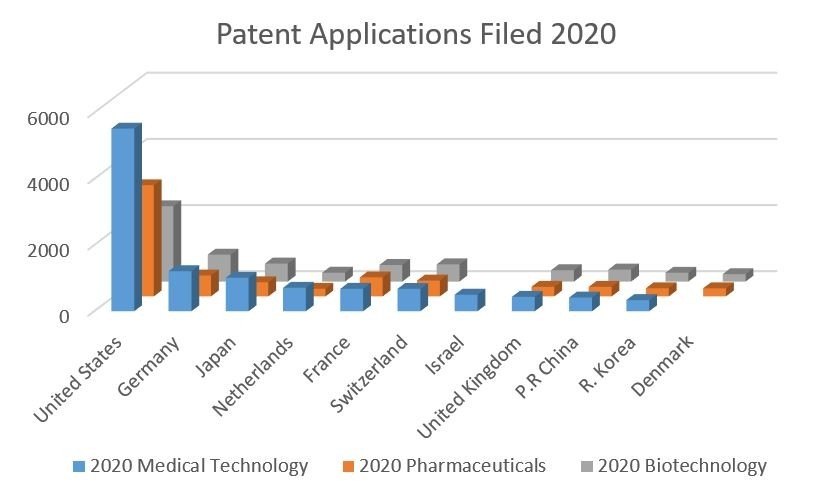
This bar chart from 2020 EPO data captures the dominance clearly: the United States leads by a wide margin in both medical technology and biotechnology filings, followed by Germany and others. The pattern has only strengthened since, as CRISPR-based therapies, synthetic biology platforms, and gene-therapy vectors continue to flood patent offices worldwide.
Accurate biological patent translation therefore demands specialists who treat every term as non-negotiable. They follow HGNC gene nomenclature without deviation, respect IUPAC conventions for chemical groups, and preserve sequence notations exactly—whether in FASTA format descriptions or GenBank accession references. They understand that “sgRNA” is not interchangeable with a generic “guide RNA” and that a promoter’s “enhancer element” carries distinct functional weight in legal claims.
General translators miss these nuances. Only those steeped in molecular biology can ensure a Chinese examiner reviewing a U.S.-origin patent grasps the same recombinant DNA construct that a European counterpart evaluates. The result? Seamless protection across USPTO, EPO, CNIPA, JPO, and beyond.
The complexity grows with international strategy. Biotech innovators file in multiple jurisdictions simultaneously, often under the PCT route, then enter national phases where translation quality decides whether the patent stands or falls. A robust biotech IP translation process prevents that single weak link.
At the end of the day, the difference between a patent that locks in market exclusivity and one that leaks value comes down to expertise in the language of life sciences. Companies that have spent years mastering translation services—while also handling video localization, short drama subtitle localization, game localization, multilingual dubbing for short dramas and audiobooks, and extensive multilingual data annotation and transcription—bring exactly the depth required. Artlangs Translation stands in that category. With command of more than 230 languages and a track record built on hundreds of complex projects, their team delivers biological patent translations that preserve every genetic detail, every structural claim, and every microbiological nuance. Their clients’ success stories speak for themselves: protected innovations that travel the globe without losing a single base pair of meaning.